Legal & Safety
Fair Use and Video Downloads

Fair use is a defence, not a permission slip. It is something a court decides after the fact by weighing four factors — it is not a box you tick before downloading. It genuinely protects criticism, commentary, news reporting, teaching and research. It does not protect ‘I am not making money from it’, which is the belief that gets people into trouble. This is US law; other countries work differently.
The four factors, and which one usually decides
| Factor | Favours fair use when… |
|---|---|
| Purpose and character | You transform it — commentary, criticism, parody, teaching |
| Nature of the work | It is factual rather than creative |
| Amount used | You take only what your point requires |
| Effect on the market | Your use does not substitute for the original |
They are weighed together, not scored. But the first and fourth carry the most weight in practice, and they tend to point the same way: a use that genuinely transforms the work rarely competes with it, and a use that substitutes for the original rarely transforms anything.
‘Transformative’ is the word to understand. It does not mean edited, shortened or re-uploaded with a different title. It means the work is being used for a different purpose than the original served — to say something about it, rather than to deliver it again.
What fair use plausibly covers
- Criticism and review. A clip inside a video essay analysing it. The classic case, and the strongest.
- Commentary and reaction with substance. Substance being the operative word — pausing occasionally to react is weaker than analysing.
- News reporting. Using footage of an event to report on that event.
- Teaching. Showing a clip in a lesson to make a point about it.
- Parody. Work that comments on the original by imitating it.
- Scholarship and research. Including saving material to study it.
Notice what these share: the original is being discussed. It is not being redelivered to an audience that would otherwise have watched it at the source.
What it does not cover, however it feels
Four beliefs that appear constantly and are all wrong:
‘I am not making money from it.’ Non-commercial use helps under the first factor and settles nothing on its own. Plenty of non-commercial uses fail the other three.
‘I credited the creator.’ Attribution is good manners and has no bearing on copyright. Naming the author of what you copied does not make copying permitted.
‘It is only ten seconds.’ There is no safe duration. Ten seconds can fail if it is the part everyone watches for; several minutes can pass in a genuine analysis.
‘It is for personal use.’ Personal use is a reasonable argument under the fourth factor and is not the same thing as fair use. In the US, personal copying has no general statutory exception — unlike much of Europe, which handles it through a private copying exception instead.
The complication people miss: circumvention
Fair use is a defence against copyright infringement. In the US there is a separate rule that fair use does not automatically excuse.
Section 1201 of the DMCA prohibits circumventing technical protection measures. It is a distinct offence from infringement, and the argument that your underlying use was fair does not, by itself, dispose of it — courts have treated the two as separate questions.
In practice this matters most where content is behind DRM: paid streaming services, rentals, protected downloads. Publicly posted video that anyone can watch without circumventing anything sits differently, which is why the distinction is worth understanding rather than lumping all downloading together.
This is also why blanket claims in either direction are unreliable. ‘Downloading is always illegal’ and ‘fair use covers me’ are both too simple to be useful, and the difference between them is usually what the video was protected by.
Being deliberate about it
You cannot make a use fair by declaring it so. You can make a genuinely fair use defensible:
- Use only what your point needs. If the argument works with twenty seconds, using two minutes weakens the third factor for nothing.
- Add substance around it. The commentary should be the work; the clip should support it, not be it.
- Do not let it substitute. If someone can watch your version instead of the original and lose nothing, the fourth factor is against you.
- Prefer licensed material where it exists. Creative Commons and public domain footage removes the question entirely.
- Ask, when the use is important. Permission is slower than fair use and infinitely more certain.
And for anything with real stakes — a commercial project, a large audience, a client — this article is not the advice you need. A lawyer who knows your jurisdiction and your facts is.
Platform rules are a separate layer
Two systems apply at once and people conflate them constantly.
Copyright law decides what is lawful. Platform terms decide what a platform permits on its own service. A use can be legally fair and still breach a platform's rules, and the consequence is not a lawsuit — it is a removed video or a closed account.
Automated content matching complicates it further. Those systems detect matching audio and video; they do not evaluate whether your use is transformative. A perfectly fair use can be flagged, and the appeal process is where the human judgement happens, if it happens.
The practical implication is that being right is not the same as being unaffected. Creators who rely on fair use routinely deal with claims they eventually win, and the winning takes weeks — the terms-versus-law distinction is covered in more depth here.
Why we ask the question we cannot verify
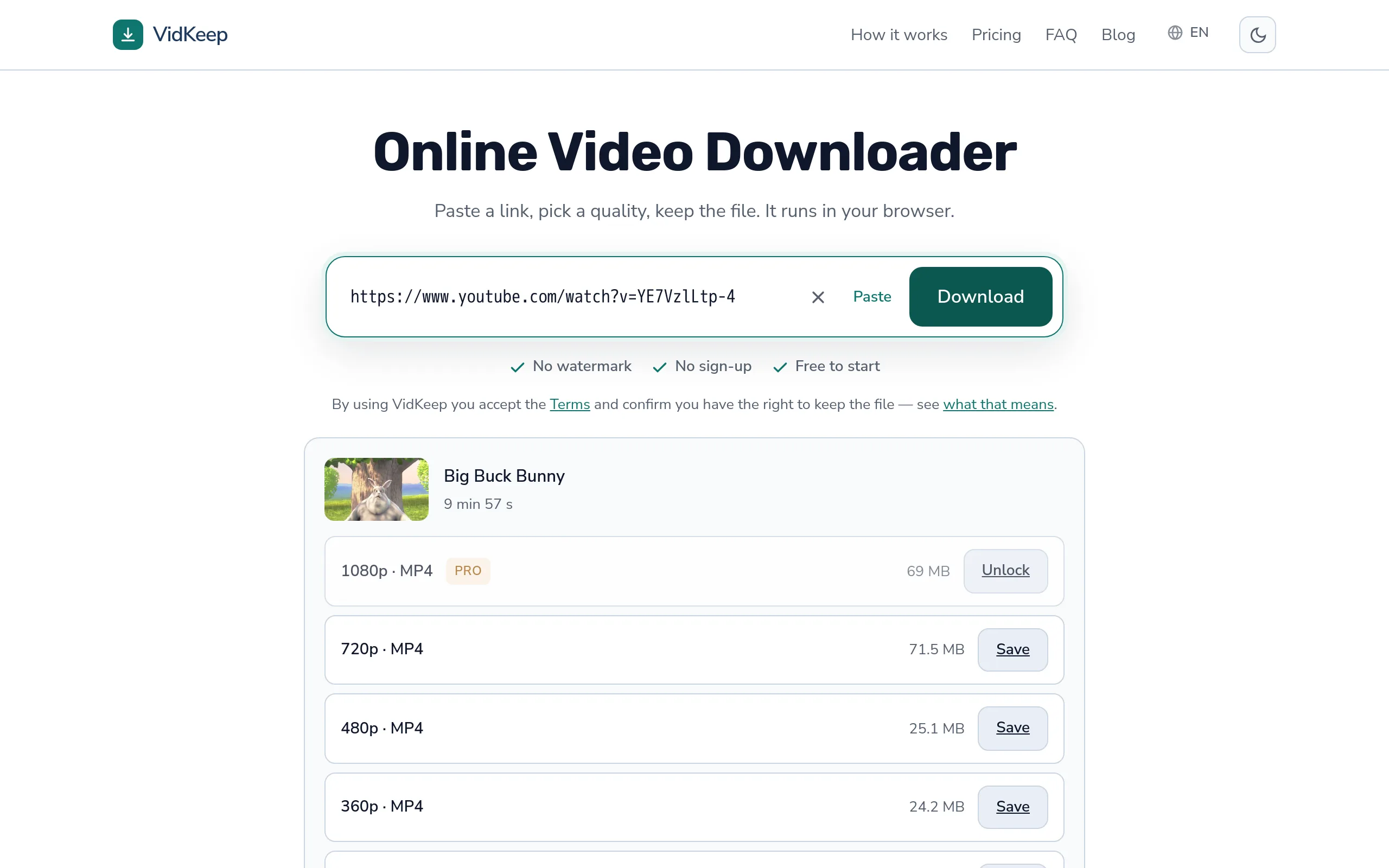
Before any download, our page states that you confirm you have the right to keep the file. It is one line, we cannot check it, and it would be easy to dismiss as theatre. It is worth explaining what it is actually for.
It is not there to shift blame. A checkbox does not transfer legal responsibility, and any service claiming otherwise has misunderstood how that works. It is there because the question is genuinely the user's to answer and nobody else is in a position to.
We know the platform, the quality and the format. We do not know whether you made the video, hold a licence, are quoting it in a review, or are about to repost it as your own. Those situations are legally different and technically identical — the same link, the same file, the same request. There is no signal in the request that separates them, which is why no downloader can filter for lawful use however much it might want to.
What we can do is not pretend the question does not exist. A great many tools in this category say nothing at all, and the silence implies that downloading is uniformly fine. It is not uniformly fine, and the cases where it is not are exactly the ones where someone would have wanted a moment's thought first.
The same reasoning shapes what we do not say. We do not tell you that downloading is legal, because it depends on your country, the material and your purpose. We do not tell you that fair use covers you, because that is a determination a court makes and we are not one. And we do not offer a way to reach private or protected content, because there is no version of that request where the answer to the question we ask is yes.
One line before a download is a small thing. It is the honest amount of friction for a question whose answer only you have.
Frequently asked questions
Does fair use let me download videos?
Fair use is a defence a court weighs after the fact, not advance permission. It protects criticism, commentary, news, teaching and research — not downloading in general.
Is it fair use if I am not making money?
Non-commercial use helps under one of four factors and settles nothing by itself. Many non-commercial uses still fail.
How much can I use safely?
There is no safe duration. Ten seconds can fail if it is the part everyone watches for; several minutes can pass in a genuine analysis.
Does crediting the creator make it fair use?
No. Attribution is good practice and has no bearing on copyright.
Does fair use cover getting around DRM?
Not automatically. US law treats circumvention as a separate matter from infringement, so a fair underlying use does not by itself dispose of it.
Can a fair use still get my video removed?
Yes. Platform rules and automated matching operate separately from the law, and those systems do not assess whether a use is transformative.
VidKeep runs in your browser — paste a link, pick a quality, keep the file. No account, no app.
Open VidKeepLast updated: 2026-09-09. We revise our guides as the platforms change.