Legal & Safety
The Private Copying Exception in the EU

There is no single European answer, but there is a clear shape. Most EU countries allow private copying — a copy made by you, for you, from a lawful source. That exception is why a downloader is legal to build and to use. What it does not cover: sharing, commercial use, and copies made by defeating a platform's technical protection — a limit the EU's top court reinforced in 2026. Here is where the line actually sits.
Does the private copying exception cover video downloads?
EU copyright law lets member states permit copies made by a natural person for private use and non-commercial ends. Most have taken that option: Germany, France, Spain and the Netherlands all allow private copies in their national law.
Three conditions travel with it almost everywhere:
- You, personally. Not for a company, a class, a client or a channel.
- From a lawful source. A video the rightsholder put up publicly is lawful. A pirated upload is not, and copying from it does not become private copying.
- Without breaking protection. If content is locked with technical measures, circumventing them is a separate offence — and the exception does not excuse it.
There is a detail most people never learn: in many EU countries you have already paid for this. A private copying levy is built into the price of storage — phones, hard drives, memory cards — and distributed to rightsholders as compensation for exactly the copies the exception permits.
How did the 2026 ruling change the private copying exception?
In 2026 the Court of Justice of the European Union addressed a question that had been unclear for years: does the private copying exception cover offline copies made from streaming services? The case was Stichting de Thuiskopie and Others v HP Nederland, Dell and Others (C-496/24), decided 16 April 2026.
The Court's answer was no, on a specific ground. Where rightsholders retain technological control over the content, private copying does not give users a right to make copies anyway. The exception is not a master key that overrides the protections a service has put in place.
The practical reading for a normal person is narrower than the headlines suggested. It does not say downloading is illegal across Europe. It says the private copying exception cannot be used as an argument for stripping protection from a controlled service.
Which is roughly the distinction people already have an instinct for: saving a publicly posted clip that anybody can watch is a different act from extracting a film out of a subscription platform that deliberately locked it.
Where the line sits in practice
| What you are doing | Where it usually falls |
|---|---|
| Saving a public clip to watch offline yourself | Private copying territory in most member states |
| Saving your own uploads | Your work — no question at all |
| Saving Creative Commons or public domain material | Permitted by the licence itself |
| Downloading to re-upload or monetise | Outside the exception entirely |
| Stripping DRM from a paid service | Separate offence; the exception does not help |
| Copying from an obviously pirated upload | Not a lawful source, so not private copying |
Notice that the technical act is identical in every row. What changes is the source, the purpose and whether protection was defeated — and those three are what the law looks at.
Terms of service are not the same as law
A point that causes endless confusion online. YouTube's terms say you should not download content except through features they provide. That is a contract between you and YouTube — and breaking it is not a criminal matter.
The consequence of breaching terms is what the contract says it is: they can restrict or close your account. That is genuinely all. Copyright law is a separate question, and it is the one that decides whether a copy is lawful.
So two things can be true at once, and usually are: a download can breach a platform's terms while falling inside a national private copying exception. People arguing on the internet routinely collapse those into one question and reach confident, wrong conclusions in both directions.
Practical guidance that holds across the EU
Not legal advice — see the note at the end — but this is the reasoning that keeps people out of trouble:
- Ask who it is for. If the answer is anyone other than you, the exception probably does not apply.
- Ask where it came from. Publicly posted by the rightsholder is a lawful source. A re-upload of a film is not.
- Ask whether anything was locked. If you had to defeat protection, that is a separate problem regardless of purpose.
- Ask what happens next. Watching it later is private use. Publishing it, even without earning anything, is distribution.
Those four questions resolve the vast majority of real situations, and they map onto the actual legal tests better than any rule of thumb about file types or tools.
Why we built the tool the way the law is shaped
This is not an abstract topic for us — the legal shape above is why our tool behaves the way it does, and several deliberate refusals come straight out of it.
We do not touch protected content. Our tool reads what a platform serves to an ordinary logged-out visitor. It does not defeat DRM, does not sign in, does not hold credentials. That is not a technical limitation we are apologising for — it is the boundary the exception itself draws. A tool that broke protection would put its users on the wrong side of a line that no private copying argument can move.
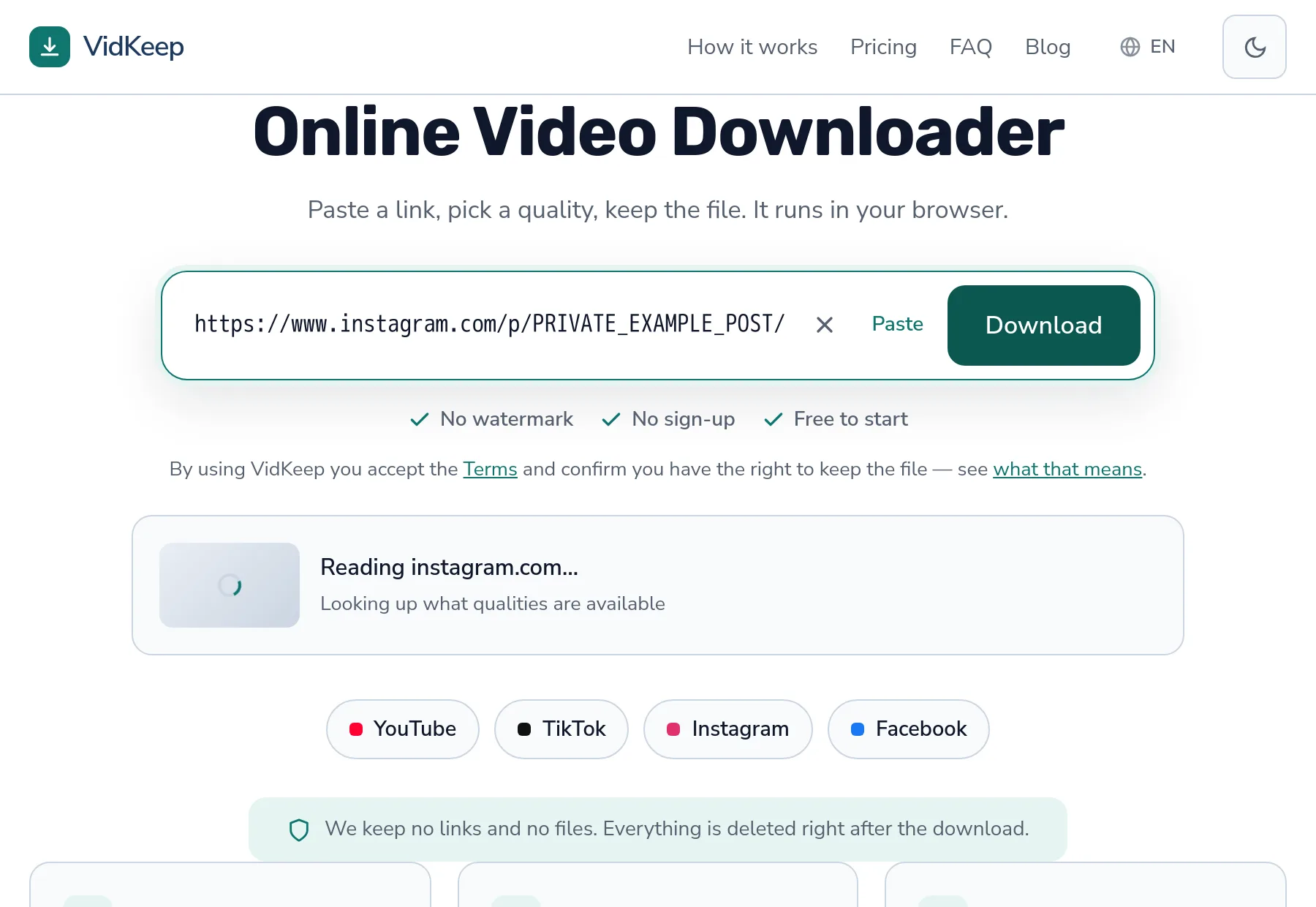
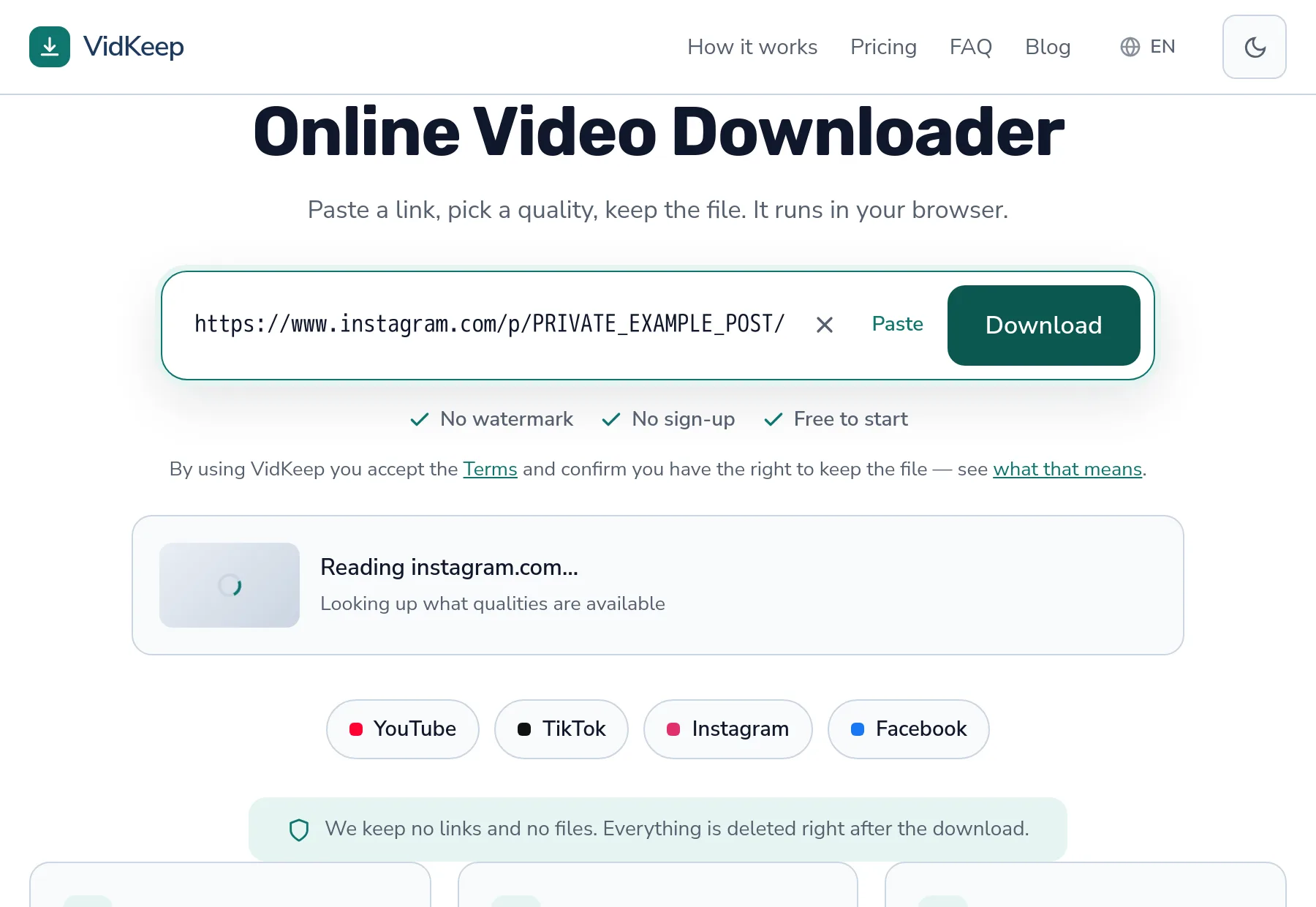
We refuse private content, deliberately. Videos behind a login return a plain message rather than a workaround. People ask for this feature regularly. The answer stays no, because ‘this content requires an account’ is the rightsholder exercising exactly the control the 2026 ruling talks about.
We say what the tool cannot decide. A downloader has no way of knowing whether a given video is the rightsholder's own upload or a re-upload of someone else's film. The lawful source condition is a judgement only the person pasting the link can make, and pretending otherwise would be dishonest. So we state it plainly on the site instead of burying it in terms nobody reads.
There is a commercial cost to all three. Every refusal is a search query we do not serve and a user who tries a competitor. We take it, because a tool built around defeating protection has a short life and a bad ending — and because the honest version is easier to explain to the person using it.
One more consequence worth spelling out, because it surprises people: these choices are also why we cannot help when something genuinely was yours. A creator who lost access to their own private upload writes to us occasionally, and the answer is the same as for anyone else — we have no login and no privileged access, so we see exactly what a stranger sees. The right route there is the platform's own account recovery, not a downloader.
It is an uncomfortable answer to give someone with a legitimate claim. It is also the only honest one, and the alternative — a tool that could reach private content when the request seemed reasonable — is precisely the tool that ends up reaching private content when the request is not.
Frequently asked questions
Is downloading YouTube videos illegal in the EU?
Not inherently. Most member states allow private copies from a lawful source for personal use. What falls outside: sharing, commercial use, and defeating technical protection.
What is the private copying exception?
A provision in EU copyright law, adopted by most member states, permitting a natural person to make copies for private, non-commercial use. In many countries a levy on storage devices compensates rightsholders for it.
Did a 2026 court ruling change this?
It clarified a limit: where rightsholders keep technological control over content, the private copying exception does not give users a right to copy it anyway. It did not make downloading generally illegal.
Does breaking YouTube's terms of service mean breaking the law?
No. Terms are a contract; the consequence is account restriction. Copyright law is a separate question with separate answers.
Is it legal to download my own uploads?
Yes. Your own work raises no copyright question at all.
Can I download a video for my class or my company?
That is outside private copying, which covers personal use by a natural person. Education and business use rely on different exceptions that vary by country.
Is the law the same in every EU country?
No. The directive gives member states options, and implementations differ — in scope, in levy arrangements and in enforcement. The shape is common; the details are national.
VidKeep runs in your browser — paste a link, pick a quality, keep the file. No account, no app.
Open VidKeepLast updated: 2026-08-10. We revise our guides as the platforms change.