Legal & Safety
Downloading Videos for Study
Education is one of the strongest positions in copyright law, and it is narrower than students assume. It protects using material to teach and learn from it — a clip in a lesson, a video you analyse in an essay, research material you study. It does not turn ‘I am a student’ into permission to build a library. The distinction is what the material is for, not who you are.
What educational use genuinely covers
- Studying a video closely. Repeated viewing, pausing, transcribing, analysing — the ordinary work of learning from something.
- Quoting a clip in coursework. A short extract supporting an argument you are making about it.
- Showing material in a class. Teaching from a clip in a lesson, which is explicitly protected in many jurisdictions.
- Research material. Saving sources you are examining, including for a dissertation or a systematic review.
- Accessibility. Adapting material so a student can actually use it is protected far more broadly than most other uses.
What runs through all of these: the video is the object of study. It is being examined, discussed or taught from, rather than simply consumed in a more convenient way.
Where it stops
Four cases that students routinely believe are covered and are not:
Building a personal library. Saving a hundred lectures because you might study them one day is collecting, not studying. The educational argument rests on use, and an unwatched archive has no use to point at.
Sharing with the class. Redistributing downloaded material to other students is a separate act from your own study, and it is the one that most often causes problems. Share the link, not the file.
Paid course content. Material you or your institution paid for comes with terms, usually including that it is not to be copied. Being a student does not override a contract you agreed to.
Anything commercial wearing an academic label. A tutorial series downloaded to run your own paid course is a commercial use however educational the content is.
How the rules differ by country
| Region | Broad position |
|---|---|
| United States | Fair use, weighed case by case; teaching and scholarship are named purposes |
| European Union | Specific exceptions for teaching and research, plus a private copying exception in most member states |
| United Kingdom | Fair dealing for research and private study, narrower than US fair use |
| Elsewhere | Varies substantially; some countries have no education exception at all |
The differences are real and not academic. ‘Fair dealing’ in the UK is a defined list of purposes rather than a flexible test, so an argument that works in the US may simply not exist elsewhere.
Two of these are covered properly in their own articles — the EU position and the US one — and both matter more than any general rule about students.
Practical rules that keep you clear
- Check your institution first. Universities have policies, and they are usually more specific and more restrictive than the law. That policy is what will actually be applied to you.
- Take what you need, not what exists. The clip you are analysing, not the whole series.
- Cite it. Not a legal shield, but academic integrity is a separate standard you are also held to, and it is the one more likely to be enforced.
- Do not redistribute. The single line that turns personal study into something else.
- Prefer openly licensed material. Creative Commons lectures, university open courseware and public domain footage remove the question entirely.
Point one is the one worth doing today. Most institutions publish this, most students have never read it, and it is a page rather than a document.
The practical case that comes up most
Poor internet is the real reason most students download lectures, and it is worth addressing directly rather than pretending the motivation is always scholarly.
Streaming a two-hour lecture on an unreliable connection is genuinely difficult. Downloading it once and watching offline is a better experience, uses less data overall, and is what the material is for. That is a strong position on the merits.
It is also often unnecessary. Many platforms hosting course material offer their own offline mode, and many universities distribute recordings directly. Those routes are sanctioned, better quality, and involve no argument at all — checking takes a minute and is worth doing before reaching for an external tool.
Where no such option exists, the practical advice is the same as everywhere else: take the lecture you are studying, keep it while you need it, and do not build a collection. Audio only is frequently enough for a talking-head lecture, and costs a fraction of the space.
For teachers rather than students
The position is stronger and the constraints are different.
Showing a clip in a lesson is explicitly protected in many jurisdictions, including through specific teaching exceptions in EU member states. Analysing material with a class is close to the centre of what these exceptions exist for.
What is not automatically covered is distributing copies to students, uploading material to a course platform, or building a shared resource library. Those are redistribution, and they need either a licence, a platform's own tooling, or an institutional agreement — many universities hold blanket licences that already cover exactly this, which is another reason to ask before improvising.
The reliable pattern: link rather than copy, use the institution's own systems where they exist, and keep local files to what you are personally presenting from.
Why students are the group our free tier was designed around
The shape of our free tier came partly from thinking about this use, and it is worth being explicit about because it explains some otherwise odd decisions.
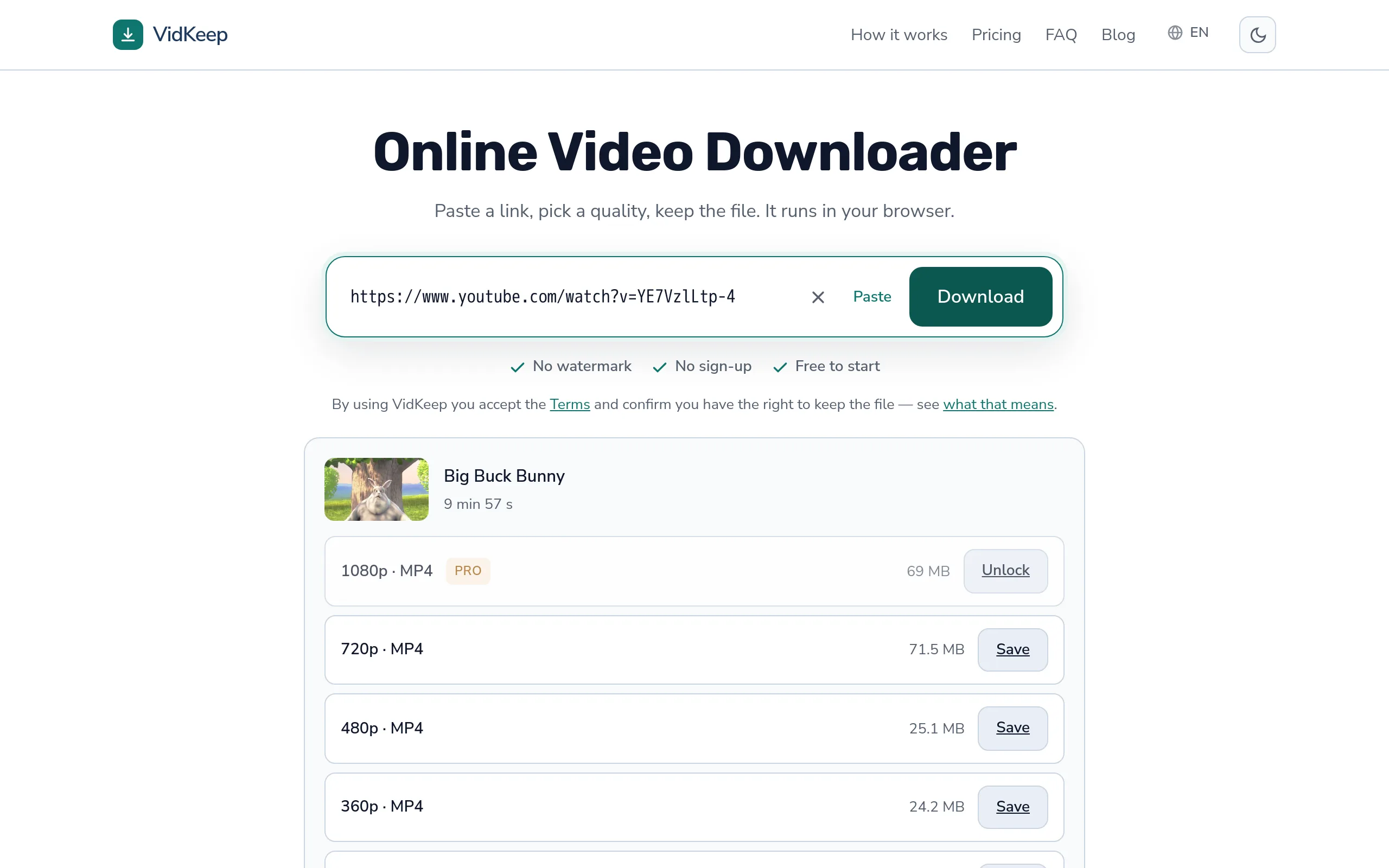
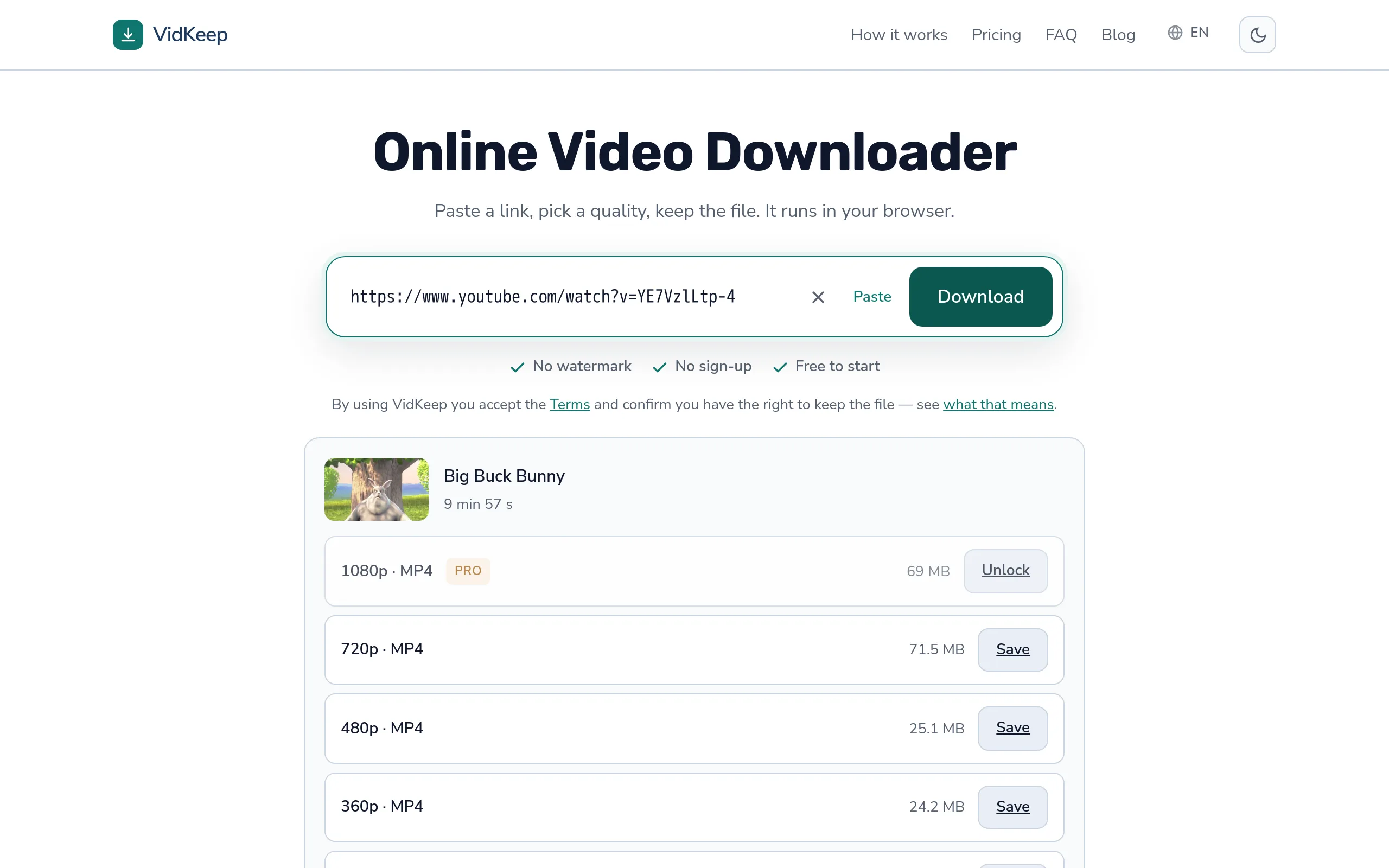
Thirty downloads a day, ten of them above 720p, with the platform's own audio track and 360p not counted at all. That looks arbitrary until you consider what a student actually does: a handful of lectures, mostly talking heads where resolution barely matters, often listened to rather than watched. Audio is free and uncounted, so the most common study pattern costs nothing indefinitely.
The 720p line matters more than the numbers. Free covers everything up to 720p including the qualities that need assembling on our side — which costs us real processing we could have charged for. We measured it: a 720p assembly took about five seconds and produced a 19 MB file. That is affordable to give away, and giving it away means a student never meets a paywall for a lecture recording.
What we deliberately did not build is the feature this group asks for most: bulk downloading of a whole course. Partly because fifty rapid requests produce a rate limit rather than fifty files, and handing someone a broken archive is worse than not offering one. But also because the educational argument is strongest for material you are studying and weakest for material you are collecting, and a one-click course archiver is a tool for collecting.
That is a commercially strange thing to say — bulk downloading is exactly the feature that would justify an upgrade, and declining to build it costs us the sale. We would rather the product fit the use that is defensible than optimise for the one that generates revenue, particularly when the people concerned are students who will carry the consequence and we will not.
The honest limitation, stated so nobody is surprised: if you need an entire semester of recordings, we are not the right tool. Your institution almost certainly distributes them, and that route is sanctioned, higher quality and free.
Frequently asked questions
Can I download videos for schoolwork?
Educational use is well protected when the video is the object of study — analysed, quoted or taught from. Being a student is not itself the permission.
Can I download a whole lecture series to keep?
That is collecting rather than studying, and the educational argument rests on use. Take what you are working with.
Can I share downloaded material with classmates?
No — redistribution is a separate act from your own study and the one most likely to cause problems. Share the link instead.
Does it matter which country I am in?
Substantially. US fair use is a flexible test; UK fair dealing is a defined list; EU states have specific teaching and research exceptions. Some countries have none.
Can teachers show downloaded clips in class?
Showing material in teaching is explicitly protected in many jurisdictions. Distributing copies to students is a different question and usually needs a licence.
What about paid course content?
It comes with terms, usually prohibiting copying. Being a student does not override a contract you or your institution agreed to.
VidKeep runs in your browser — paste a link, pick a quality, keep the file. No account, no app.
Open VidKeepLast updated: 2026-09-28. We revise our guides as the platforms change.