Legal & Safety
What the TikTok Watermark Actually Is

The moving username and logo is added when the app exports a copy — it is not part of the stored video. So a clean download is not erasing anything; it is the file before the stamp was applied. That distinction matters, because the stamp exists to carry credit, and whether removing it is fine or not depends entirely on whose video it is.
What the stamp is for
It does two jobs, and only one of them is about the platform.
Attribution. The username travels with the clip. When a video is shared to another app, saved to a phone, or reposted, whoever sees it can find who made it. For creators that is genuine value — a share that carries a name is discovery, and one that does not is anonymous.
Promotion. The logo advertises TikTok wherever the clip travels, which is why it is animated and positioned to be hard to crop.
The two are bundled, and that bundling is the source of most of the argument. People removing the stamp for legitimate reasons are also removing attribution, whether or not that was the intention.
Why a clean file is not an edit
Two completely different things get described the same way, and the results are not comparable.
| Fetching the source file | Erasing the stamp | |
|---|---|---|
| What happens | The stored video is retrieved | The area is blurred or painted over |
| Result | Identical to the original | A visible smear that moves |
| Quality | Unchanged | Degraded, and re-encoded |
If a clip you have looks smudged in one corner, that is the second method. The first leaves no trace because there was nothing to remove — the practical guide covers how to tell them apart.
This is also why ‘watermark remover’ is a misleading name for the honest version of the tool. Nothing is removed. A different copy is fetched.
When taking it off is entirely reasonable
- Your own video. You made it; the attribution is to you. Cross-posting your own work with another platform's logo on it is penalised by most recommendation systems and looks like a repost.
- Archiving your own catalogue. Keeping clean copies of your work is what a backup is.
- Editing material you have rights to. A stamp burned into footage is a problem in any edit.
- Personal viewing. Saving something to watch offline, where nobody else will see it and attribution serves no one.
What connects these: either the credit belongs to you, or no third party ever sees the file. The stamp's purpose is not being defeated.
When it crosses a line
The opposite case is worth naming as plainly.
Reposting someone else's clip as your own. This is what the stamp exists to prevent, and removing it to do this is exactly the harm. It also tends to be obvious to the audience and to the original creator.
Using a creator's work in commercial material. The watermark is not what makes this a problem — copyright is — but stripping it removes the trail. Commercial use has its own analysis.
Building a channel from other people's clips. Common, penalised by platforms as unoriginal content, and the fastest route to complaints from the people whose work it is.
Worth being clear that removing a watermark is not itself the legal question — using someone's video without permission is a problem whether the stamp is there or not. The stamp is evidence, not the right.
Credit without the logo
If the reason you want a clean file is that the stamp is ugly rather than that you want to hide where it came from, attribution has better forms.
- Name the creator in the caption. More useful than a moving watermark, and readable.
- Tag their account. Turns credit into a link they benefit from.
- Ask first for anything with reach. Most creators say yes, and an explicit yes is worth more than any argument afterwards.
- Link the original where the platform allows it.
The test that settles most cases: would the creator be pleased to see what you did with their clip? A repost with a tag usually yes. An uncredited clip on a brand account, no.
Why platforms penalise watermarked reposts
A practical dimension that people discover the hard way when cross-posting.
Recommendation systems on every major short-video platform down-rank content carrying another platform's watermark. The logic is straightforward: a competitor's logo is an advertisement for the competitor, and recycled content is worth less to them than original material.
So a creator posting their own TikTok to Reels or Shorts with the stamp intact is penalised for their own work. That is the single most common legitimate reason people look for a clean file, and it is a platform-competition problem rather than a rights one.
The reverse also holds. A clean file is treated as native content, which is why cross-posting properly is worth the extra step for anyone maintaining more than one account.
Why we serve the clean file and say so plainly
Our TikTok downloads have no watermark. That is a selling point in this category and it is worth explaining what we are and are not claiming, because the language around it is consistently misleading.
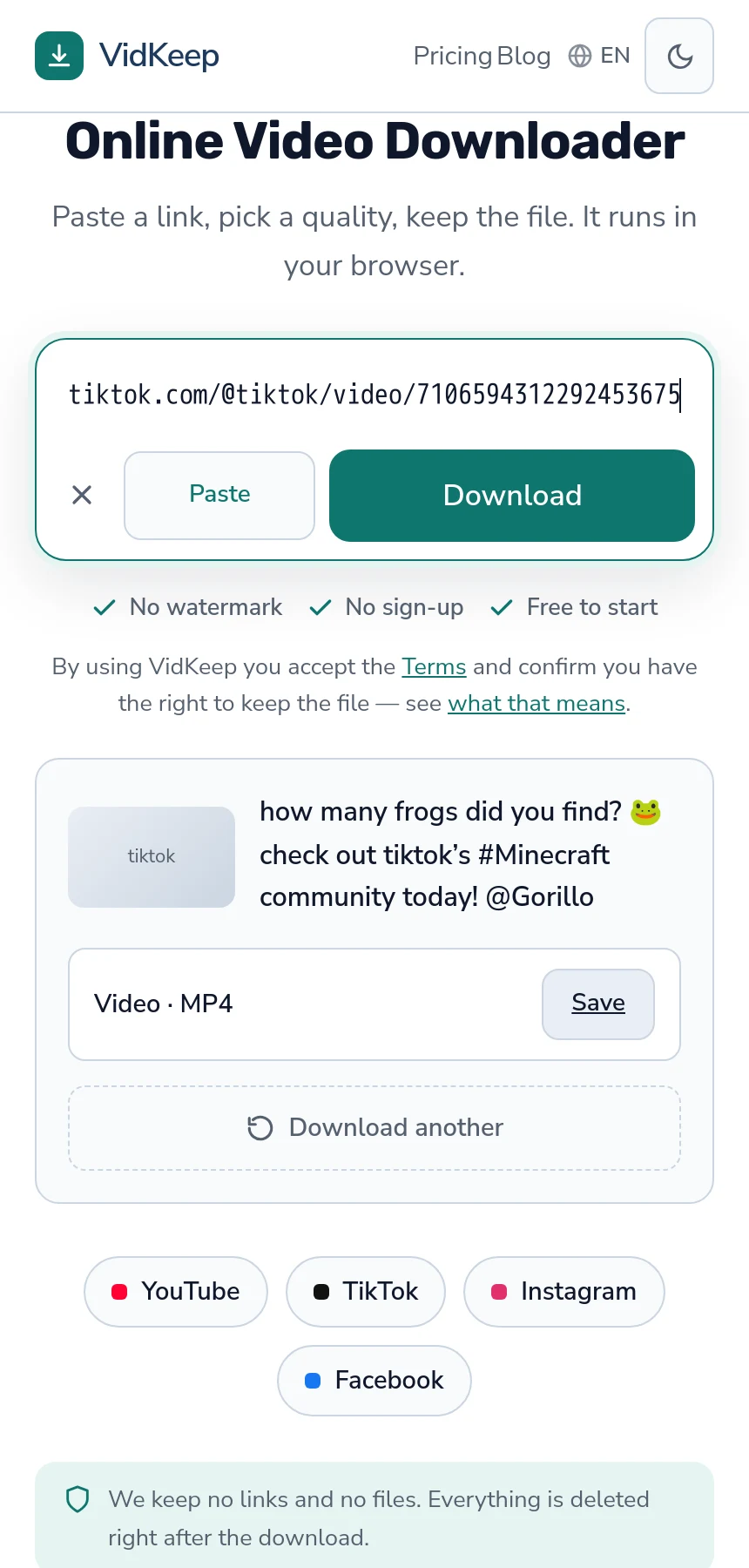
We do not remove anything. When a TikTok link comes in, we ask the platform for the video and receive the stored file — the one the watermark was never applied to, because the stamp is added at export time for in-app saving. There is no processing step, no blurring, and no re-encoding. Calling that ‘watermark removal’ would describe a capability we do not have and do not need.
What we deliberately do not build is the other kind of tool. Blur-and-inpaint removal, cropping to cut the stamp out, or anything that alters the picture to hide a mark — none of it is in the product. Partly because the results are visibly worse than the source, and partly because that class of tool exists to defeat attribution rather than to retrieve a file, and those are different businesses.
The confirmation before every download applies here with more force than usual. TikTok is where the gap between ‘my own video’ and ‘someone else's video I am about to repost’ is widest, and both produce an identical request: same link, same file, same response. We cannot tell them apart and we are not going to pretend the question is settled by our being able to serve it.
One consequence of the honest version worth knowing: because we hand over the stored file untouched, TikTok downloads have no quality menu and often no size shown. There is one file and the platform does not always report how big it is. That is less impressive than a list of resolutions, and it is what actually exists.
Frequently asked questions
What is the TikTok watermark for?
Attribution and promotion. It carries the creator's username wherever a clip travels, and advertises the platform at the same time.
Is removing the watermark the same as erasing it?
No. A clean download is the stored file, which never had the stamp — it is added when the app exports a copy. Tools that blur it out leave a visible smear.
Is it legal to remove a TikTok watermark?
The watermark is not the legal question — using someone's video without permission is a problem whether the stamp is present or not. For your own work there is no issue.
Why do platforms down-rank watermarked videos?
Another platform's logo advertises a competitor, and recycled content is worth less to them than original material. Creators are penalised for their own cross-posts.
How should I credit a creator without the watermark?
Name them in the caption and tag the account. Both are more useful than a moving stamp, and asking first is worth more than either.
Why is there no quality choice for TikTok downloads?
TikTok stores one finished file per video rather than a ladder of resolutions, so there is nothing to choose between.
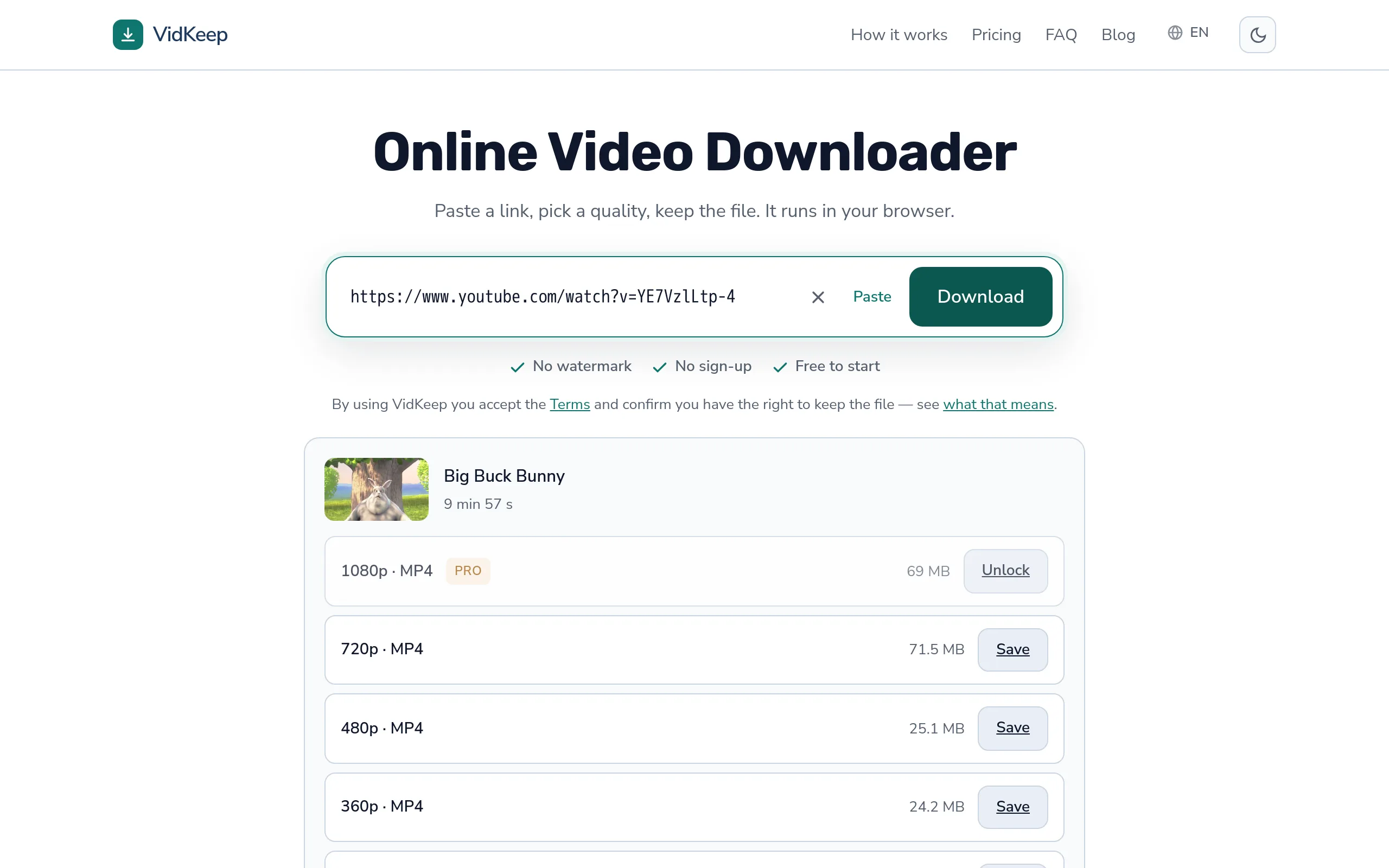
VidKeep runs in your browser — paste a link, pick a quality, keep the file. No account, no app.
Open VidKeepLast updated: 2026-10-07. We revise our guides as the platforms change.