Legal & Safety
Age-Restricted Videos: The Honest Answer

You cannot download them with a browser tool, and no tool that says otherwise is doing what it claims. An age gate requires a signed-in account with a verified age. A downloader has no account and never will — there is nothing for it to sign in with. That is the restriction working, not a gap waiting to be engineered around.
What the restriction actually is
Age-restricted content is not private and not removed. It is public, and the platform requires proof of age before serving it — usually a signed-in account, sometimes an additional verification step depending on the country.
The check happens before the video data is available at all. A logged-out request does not receive a lower-quality version or a truncated file; it receives a refusal. There is nothing to extract because nothing was served.
This distinguishes it from most other failures. A private video is invisible to everyone outside a circle; a removed video no longer exists; an age-restricted video exists, is public, and is being withheld from anyone who has not identified themselves.
Why claims to bypass it are hollow
Search this and you will find services promising age-restricted downloads. Three things are usually happening, and none of them is what is advertised.
Account pools. The service holds signed-in accounts and uses them to fetch content. This works, breaches the platform's terms, and collapses whenever those accounts are detected and closed — which happens regularly.
Nothing at all. The site accepts your link, shows a progress animation, and produces an error or an unrelated file. The claim exists to attract the search traffic.
Something worse. The page requires you to sign in with your own account ‘to verify your age’. That is a credential harvest wearing a plausible explanation, and handing over an account is a far larger loss than not getting the video.
The third is the one to watch for. A legitimate downloader never needs your platform login, for any video, under any circumstances — the same pattern appears around private content.
What is genuinely available to you
- Watch it signed in. The intended route. If you have an account with a verified age, the video plays normally.
- Check for an unrestricted copy. Creators sometimes post edited versions elsewhere, and the restriction is per video rather than per creator.
- Ask the creator. Restrictions are occasionally applied automatically and in error, and a creator can appeal or adjust them.
- Accept it. Sometimes the honest answer, and better than the routes that cost you an account.
What is not on this list is any technical workaround, because there is not one that does not involve credentials belonging to somebody.
The messages that look similar
| Message | Cause | Reachable? |
|---|---|---|
| Sign in to confirm your age | Age restriction | Only signed in |
| Sign in to confirm you're not a bot | Rate limiting | Yes, after waiting |
| This video is private | Owner restricted it | No |
| Members-only | Paid relationship required | No |
| Not available in your country | Region block | Depends on where the server is |
The first two are constantly confused because both mention signing in, and they are completely different. The bot check is temporary and clears by itself; the age gate is permanent for anyone without an account — the bot check is covered separately.
Telling them apart is easy: if it worked ten minutes ago and stopped after several downloads, that is rate limiting. If it has never worked for that specific video while others are fine, that is the age gate.
Why platforms apply it, and why it is imperfect
Age restrictions exist for legal reasons that vary by country, and platforms apply them in three ways: creators mark their own content, automated systems flag it, and users report it for review.
The automated part is why the system produces odd results. A video can be restricted for a brief scene, for language, or for a subject matter that a classifier misread — and creators frequently discover the restriction only when their views collapse.
None of that changes what a downloader can do. Whether the restriction was correctly applied is a question between the creator and the platform, and from outside there is no distinction between a fairly restricted video and an unfairly restricted one — both are withheld identically.
It also means the answer can change. A successful appeal removes the restriction, and a video that was unreachable last month may be ordinary this month. That is the one form of waiting that occasionally works.
If the video is yours
Creators hitting this on their own content have a route nobody else does.
Your platform's creator tools give you access to your own uploads regardless of the restriction, including a download of the version the platform holds. That is better quality than anything an external tool would reach even if the restriction did not exist, because the platform has no reason to serve you a reduced copy of your own work.
You can also appeal a restriction you believe was applied incorrectly, and for automatically flagged content that is frequently successful.
What you cannot recover is your original upload — what comes back is always the platform's re-encoded version, which is a reason to keep your exports rather than relying on recovery.
Why we return a specific message instead of trying harder
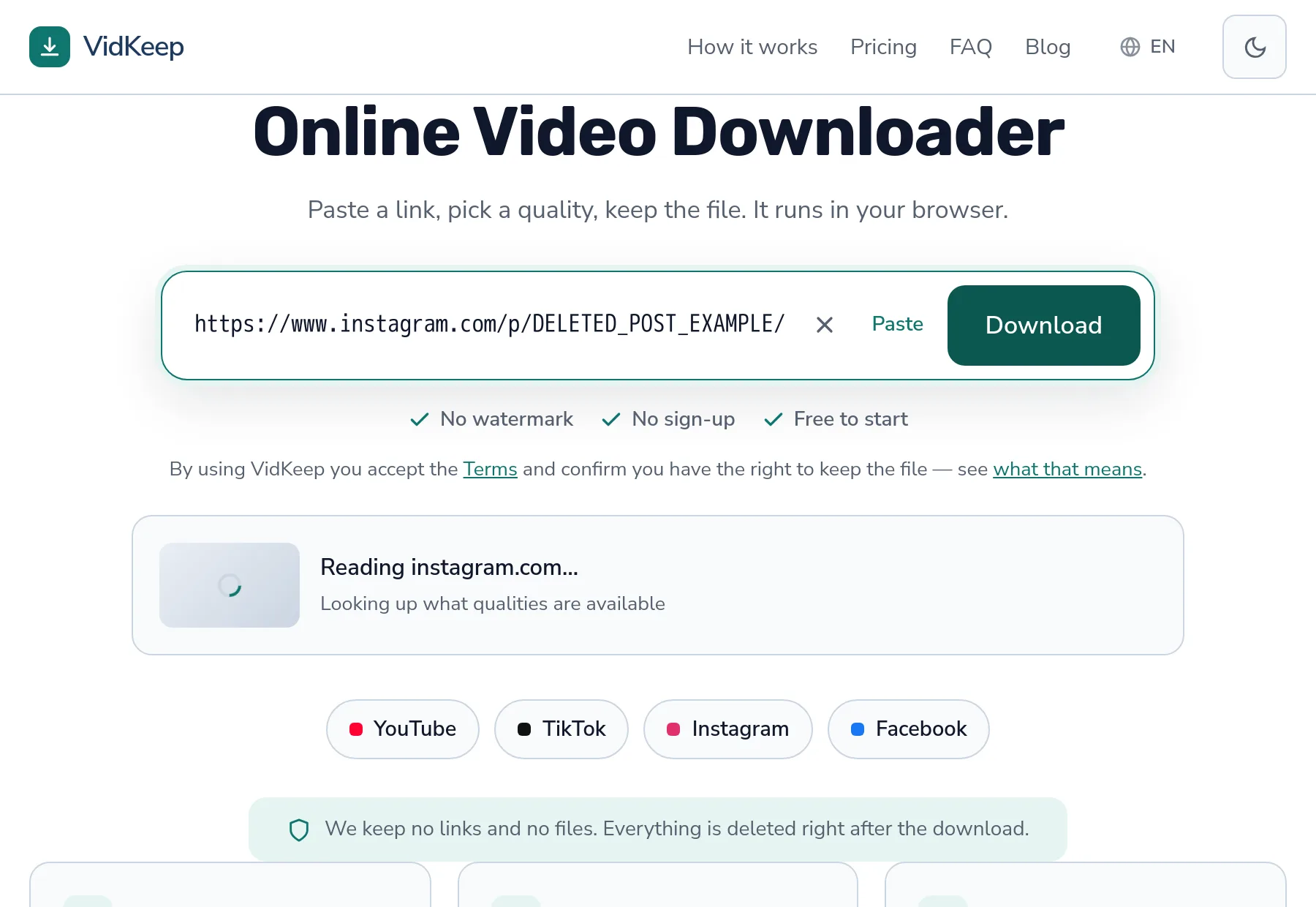
When a platform tells us a video needs a login, our code recognises that answer and turns it into a plain sentence: this post is private or requires a login, and only public posts can be saved. It would be technically straightforward to do something else, and the reasons we do not are worth stating.
The first is that there is nothing to try. Age verification is not a check we could satisfy with a better request, a different header, or a retry — it requires an identity, and the service does not have one. A tool that retried repeatedly would produce the same refusal more slowly while consuming its own rate limit.
The second is about what a message is for. We could return a generic failure and let people conclude the tool was broken, which is what happens on a lot of sites. That reliably sends someone to try four alternative services, all of which fail identically, before anyone works out that the video was the constraint. Naming the cause ends the search in one step, and ending a search is more useful than looking capable.
The third is that we are not going to build the thing that would work. Holding a pool of signed-in accounts to fetch age-restricted content is the only approach that actually functions, and it means operating accounts against a platform's terms, having them closed periodically, and replacing them. That is a business we have decided not to be in — not because the engineering is hard, but because the product it produces breaks unpredictably and its reliability depends on a supply of accounts.
The consequence for you is a service that says no more often than some competitors appear to. We would rather be the tool that tells you which door is locked than the one that rattles the handle convincingly.
Frequently asked questions
Can I download age-restricted videos?
Not with a browser-based tool. The platform requires a signed-in account with a verified age, and a downloader has no account to sign in with.
Do tools that claim to bypass age restrictions work?
They either use pools of signed-in accounts against the platform's terms, do nothing at all, or ask for your own login — which is a credential harvest.
Should I ever sign in to a downloader?
No. A legitimate tool never needs your platform login for any video, under any circumstances.
Is 'confirm your age' the same as 'confirm you're not a bot'?
No. The bot check is temporary rate limiting that clears by itself. The age gate is permanent for anyone without a verified account.
Why is this video age-restricted at all?
Creators mark content, automated systems flag it, and users report it. Automatic flagging produces false positives, which creators can appeal.
It is my own video. Can I get it?
Yes, through your platform's creator tools, which give you access regardless of the restriction and better quality than any external tool.
VidKeep runs in your browser — paste a link, pick a quality, keep the file. No account, no app.
Open VidKeepLast updated: 2026-10-12. We revise our guides as the platforms change.