Guides
Two Apps That Look Like One

Same company, same interface, entirely separate services. Douyin is the Chinese app and TikTok is the international one, and they run on different catalogues, different domains and different access rules. Practically: TikTok links download normally; Douyin links, from our servers on 2 August 2026, do not.
What we actually get back
| Platform | Link looks like | Our result |
|---|---|---|
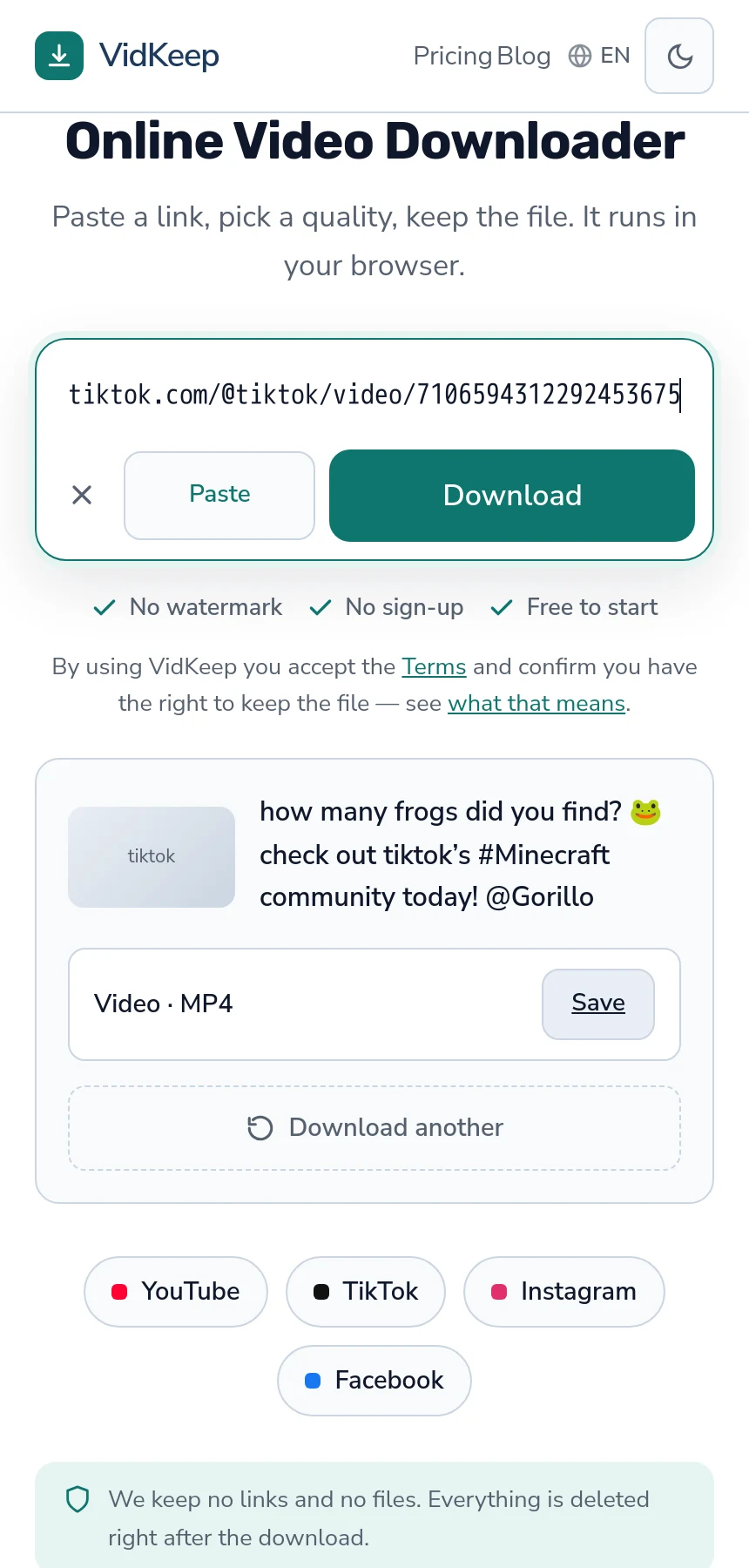
| TikTok | tiktok.com, vm.tiktok.com, vt.tiktok.com | Works — one MP4 option with sound |
| Douyin | douyin.com, v.douyin.com | Refused — a session is required |
The Douyin refusal is specific rather than vague: it asks for fresh cookies, which means an authenticated browser session. That is not something a service can hold on your behalf, and we will not ask you for one.
Tested from our own infrastructure, which matters — a request from a home connection in China is a different request entirely. This is a statement about what we can do, not about what the platform does for everyone.
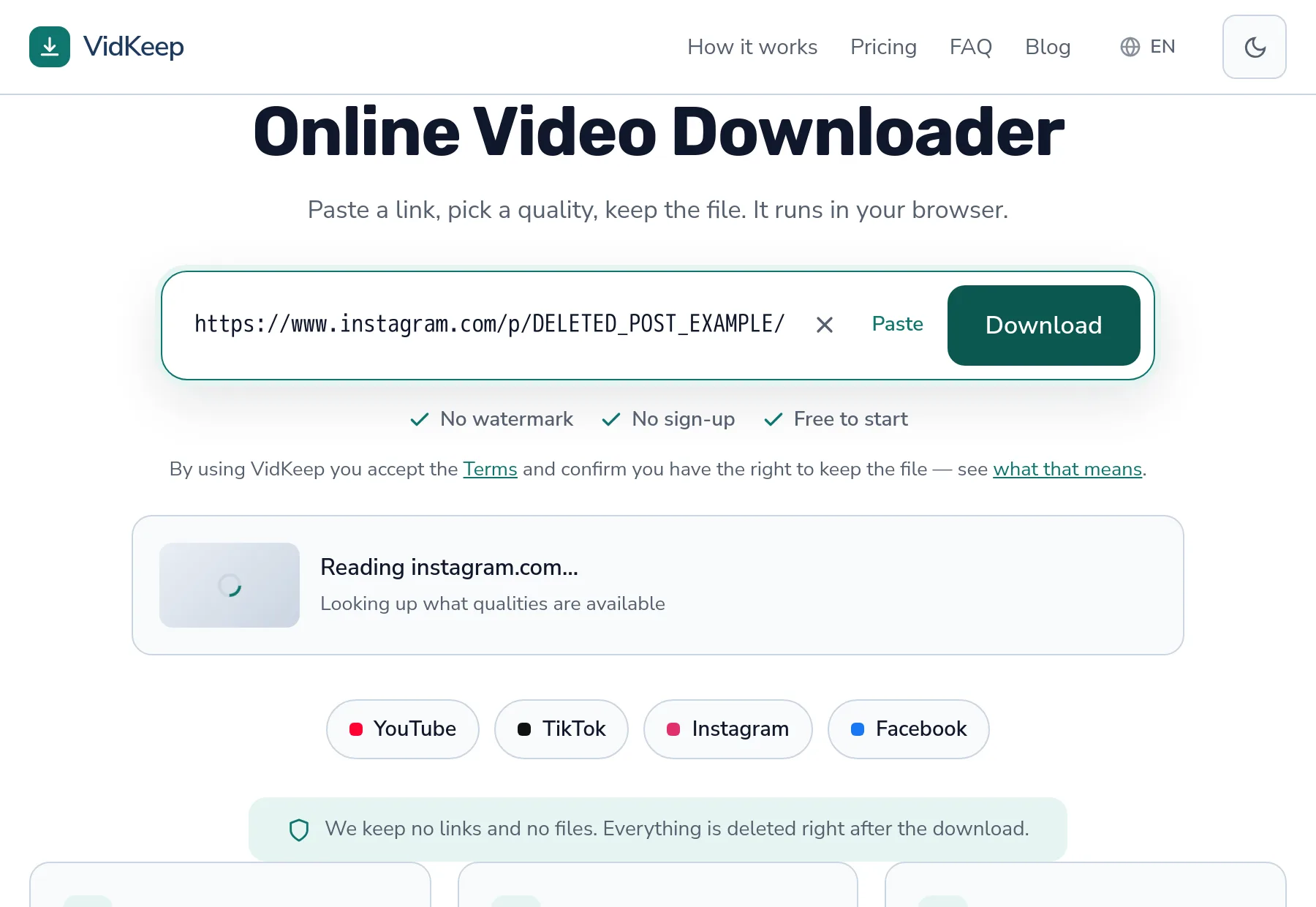
The TikTok side is worth describing precisely too. What comes back is a single finished file with sound rather than the ladder of resolutions a YouTube link produces, because short-video platforms store one prepared file rather than separate streams — what quality that actually is.
Which is also why TikTok downloads feel instant: there is nothing to assemble, so the only wait is the transfer itself.
Why they are separate in the first place
This is not a regional skin over one product. They were built as two services and have stayed that way.
The shared owner is genuinely the only thing they have in common, and it explains less than people assume.
Different catalogues. A video posted to Douyin does not appear on TikTok and the reverse is equally true. Accounts, follower lists and comment threads are unconnected, which is why searching TikTok for something you saw on Douyin fails.
Different infrastructure. Separate domains, separate content servers, separate authentication. From the outside they are two websites that happen to resemble each other.
Different rules. Douyin operates under Chinese regulation, including features TikTok has no equivalent of. The apps diverge in ways that go well beyond the language of the interface.
For anyone trying to download, the consequence is simple: knowing how TikTok behaves tells you almost nothing about how Douyin will.
It also explains a confusion people run into constantly: a creator with the same name on both is often two accounts run by the same person, and sometimes two different people entirely. There is no shared identity between the services.
The features diverge too. Douyin has had payments, mini-programs and search behaviours that TikTok never shipped, which is why screenshots from one app can look unfamiliar to a regular user of the other.
Reading the link
- tiktok.com/@user/video/… — the full international form, and the one that always works.
- vm.tiktok.com/… and vt.tiktok.com/… — shortened share links. They redirect to the full form and are fine to paste — the formats explained.
- douyin.com/video/… — the Chinese full form.
- v.douyin.com/… — the Chinese share link, and the one people most often mistake for a TikTok link because it arrives from a chat with no context.
If a link came from someone in China, or the app it came from displayed Chinese text, it is almost certainly Douyin — and the domain confirms it in a second.
The share links are the ones worth looking at closely, because both companies use the same shortening pattern and a glance at v.douyin.com next to vm.tiktok.com reads as the same kind of thing. The domain is the only reliable signal.
If you paste one and get an unhelpful result, checking the domain before anything else saves the ten minutes usually spent assuming the link is broken — when a link genuinely is.
Why a session requirement is a wall rather than a hurdle
‘Fresh cookies are needed’ sounds like a technical detail and is actually the end of the conversation.
It is worth unpacking, because the same message appears on several platforms and it always means the same thing.
Cookies here mean an authenticated browser session — evidence that a real signed-in person is asking. A service asking you for those is asking for access to your account, which is the single most dangerous thing a downloader can request — why we never do.
Any tool that claims Douyin support is doing one of three things: holding accounts of its own, buying access from someone who does, or asking you for credentials. The first two are fragile and break without warning; the third you should refuse.
So the honest answer is that we do not support Douyin, and that a service promising otherwise deserves the question of how — the general version of this question.
There is a related pattern worth recognising. A tool that works for a week and then stops is usually one running on borrowed access that expired, and the site rarely says so — it just returns errors that look like your fault.
Session requirements exist precisely to stop automated access, so anything that defeats them is by definition working against the platform rather than alongside it. That is a fragile thing to depend on for a video you want today.
The watermark question, which is not the same on both
Both apps stamp exported videos, and the two are frequently discussed as one topic.
They are not one topic, and the difference is the same one running through this whole article: what is true of TikTok is a claim about TikTok only.
On TikTok, a downloaded file may or may not carry the stamp depending on the source, and either way the mark identifies the creator — removing it is a decision about attribution rather than a technical step — what removing it means.
On Douyin the same logic applies, and it is academic for us, since we cannot reach the file to begin with. Articles promising watermark-free Douyin downloads are describing a capability, not explaining one.
The reason the topic attracts so much low-quality writing is that the search demand is real and the capability mostly is not.
That gap between demand and capability is the whole economics of this category. A page can be written in minutes, will rank for a while, and nobody who bounces off it in frustration leaves a record — so the incentive runs entirely one way.
The reader-side defence is simple enough: an article that never says what it tested, on what date, from where, is describing a hope. One that names its failures is at least reporting something.
What to do with a Douyin link
- Check whether it exists on TikTok. Some creators post to both, and a TikTok copy downloads normally.
- Ask the person who sent it to save it in the app and send the file. One message, no tools, and it is the copy the creator intended to be shared.
- Screen record as a last resort, understanding what that costs in quality — the comparison.
- Do not hand credentials to anything that promises to solve this. The cost of that trade is far higher than the video is worth.
The second option is underrated. It is faster than any of the alternatives and it works today, which no amount of clever tooling on our side currently does.
It has a second advantage: the file the app exports is the one the creator intended to circulate, watermark and all, which sidesteps the attribution question entirely.
What we would not do is spend money on a paid access route for Douyin the way we do for Instagram. The demand from an English-language audience does not justify the cost, and we would rather that money went into the platforms most of you actually use — where the money goes.
What we tested, and why we publish the failures
On 2 August 2026 we went through the platforms we were considering writing about and tried each one from our own servers with real links. The results decided which articles exist on this blog, and the negative ones are worth publishing rather than quietly omitting.
Douyin answered that fresh cookies were needed — an authenticated session. Weibo redirected us to a visitor page, Bilibili returned 412 Precondition Failed, Xiaohongshu found no formats on a test identifier. Outside China, Vimeo refused with a 401 about an OAuth token, Reddit returned 403 to a plain public JSON endpoint, Rumble 403, Dailymotion timed out, Tumblr dropped the connection.
The common thread is that these are refusals aimed at datacentre addresses rather than at us specifically. Most of those sites work perfectly from an ordinary home connection. What they decline to do is answer a server, which is precisely what any web-based downloader is — the path a request takes.
We could have written the articles anyway. ‘How to download Douyin videos’ is a real search with real volume, and the page would rank on a subject we cannot deliver. That is the standard practice in this category and it is why so many results are useless: the article exists to be found, not to be right.
Instead the list of what works is published as a table on this site and the platforms that refuse us are named. TikTok, YouTube, Instagram, Facebook, X, Twitch, Snapchat Spotlight and Niconico were verified with real content on that date. The rest were not, and we would rather tell you in one sentence than waste your time on an instruction that ends in an error — the Chinese platforms in detail.
One caveat on all of it: 403 and 412 are policy, and policy changes. This table is a snapshot of one date from one network, worth rechecking every few months, and we will update it rather than leave a stale claim in place.
Frequently asked questions
Are Douyin and TikTok the same app?
Same company, separate services. Different catalogues, domains and accounts — a video on one does not appear on the other.
Can I download Douyin videos?
Not through us. Douyin requires an authenticated session, and we will not ask you for account credentials to obtain one.
How do I tell a Douyin link from a TikTok one?
The domain. TikTok links use tiktok.com, vm.tiktok.com or vt.tiktok.com; Douyin uses douyin.com or v.douyin.com.
Why do some tools claim Douyin support?
They either hold accounts of their own, buy access from someone who does, or ask you for credentials. The first two break often and the third you should refuse.
Can I find a Douyin video on TikTok instead?
Sometimes — some creators post to both. It is the first thing worth checking, because a TikTok copy downloads normally.
Does the watermark work the same on both?
The logic is the same, but it is academic for Douyin since the file cannot be reached in the first place.
VidKeep runs in your browser — paste a link, pick a quality, keep the file. No account, no app.
Open VidKeepLast updated: 2026-08-02. We revise our guides as the platforms change.