Legal & Safety
Clips in Your Own Videos

Two different things get called a copyright problem and they are not equivalent. An automated claim is a matching system saying your video contains someone's material — usually redirecting revenue, not removing anything. A strike is a legal takedown request against your account, and three of those typically end it. Being right prevents neither.
Claims and strikes, side by side
| Automated claim | Copyright strike | |
|---|---|---|
| Raised by | A matching system | A person filing a legal request |
| Immediate effect | Revenue redirected, sometimes blocked in some countries | Video removed |
| Effect on the account | None | Serious; several end it |
| Expires | Not applicable | Usually after a period |
| How common | Very | Comparatively rare |
Most creators who say they were ‘hit for copyright’ mean the first. It is unpleasant and it is not a mark against the account — the video stays up and the money goes elsewhere.
The second is a legal instrument with real consequences, and it involves a human deciding to file. That difference is worth internalising before deciding how worried to be.
Why matching systems do not assess fair use
This is the part that feels unjust and is worth understanding as design rather than malice.
Automated matching compares audio and video fingerprints against a reference library. It detects that material is present. It cannot evaluate whether your use is transformative, how much you used relative to your point, or whether you are commenting on the work — the questions a fair use analysis turns on — the four factors.
So a perfectly defensible use gets claimed, and the human judgement happens later, in an appeal, if you pursue one. Creators who rely on commentary routinely win disputes they should never have had.
The practical consequence: being right does not prevent the claim. It affects the outcome of a dispute, weeks later, and the video meanwhile earns nothing.
What actually reduces the risk
- Use less. Amount used is one of the factors, and shorter extracts are both a better legal position and less likely to match cleanly.
- Add substance around it. Your commentary should be the work; the clip supports it. A clip that stands alone as content is the weakest case.
- Avoid music entirely where you can. Music is the most actively enforced category and matching finds it reliably, including under speech.
- Use licensed or original material for anything structural. Stock and openly licensed footage removes the question.
- Ask, when it matters. Permission in writing is slower and infinitely more certain than any argument constructed afterwards.
Point three deserves emphasis. A clip whose background music is licensed to a rights holder will be claimed for the music regardless of what you did with the picture, and that is the single most common surprise in this area.
What does not help
- Crediting the creator. Good practice, no legal effect, and no effect on matching.
- A disclaimer in the description. ‘No copyright infringement intended’ is not a defence and never has been.
- Altering the clip to evade detection. Mirroring, speed changes and pitch shifts are widely known and detected. They also weaken any fair use argument, because they show intent to avoid identification.
- Using a short enough clip. There is no safe duration. Ten seconds can match and can also fail the amount factor if it is the part everyone watches for.
The third item is worth stating plainly because tools that promise it are widely advertised. Evasion is not a strategy — it is evidence.
If you are claimed
Being claimed on a use you believe is defensible is common, and the process is survivable.
Read what was claimed. Usually a specific segment, and frequently the music rather than the footage. That changes the response entirely.
Consider removing or replacing it. Most platforms offer to trim or mute the claimed section, which resolves it immediately with no dispute and no risk.
Dispute only if you have a real basis. Commentary, criticism, teaching, or a licence you hold. A dispute filed without one escalates a claim into something that can become a strike.
Keep your evidence. The link, the date, any permission — recorded at the time, not reconstructed.
The part specific to downloaded clips
Downloading changes nothing about the analysis, and it changes one practical thing.
The rights question is identical whether you obtained the clip by downloading, screen recording or a friend sending it. What matters is the use, not the acquisition — which is why the method is a quality decision rather than a legal one.
What downloading changes is quality, and quality affects matching in an unhelpful direction: a clean copy matches more reliably than a degraded one. That is not an argument for using worse footage — it is a reason not to assume a poor copy will pass unnoticed.
The other practical difference is that a downloaded file is evidence of what you used and when, which helps in a dispute and is worth keeping alongside the project rather than deleting after export.
Why the confirmation matters most to this reader
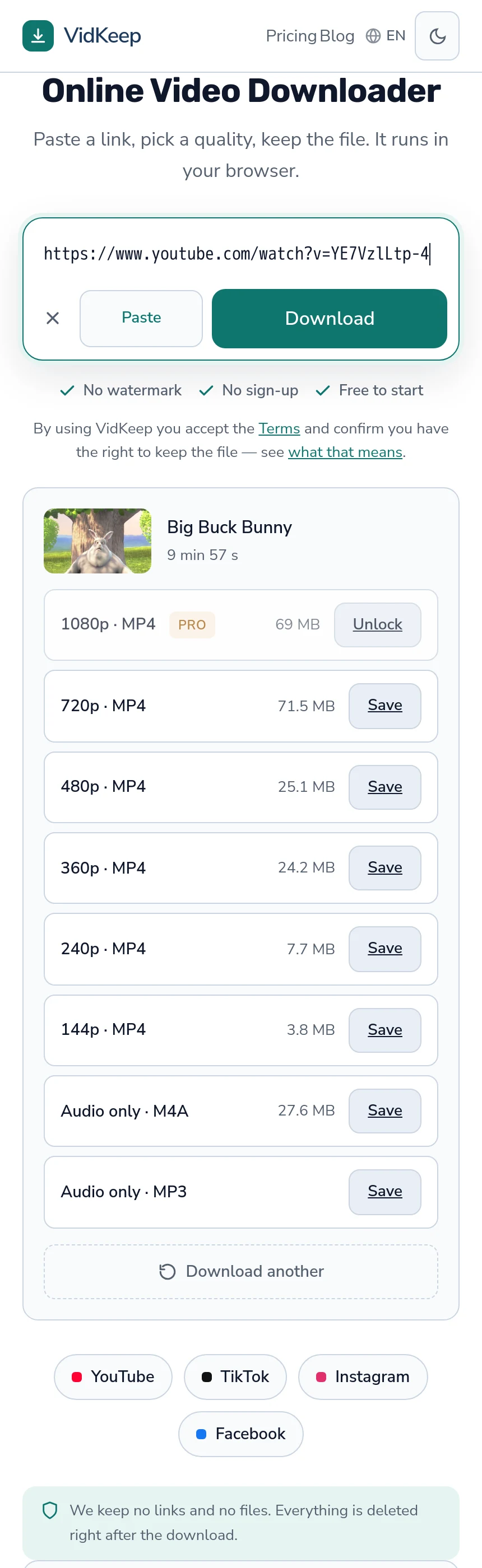
Before every download we state that you confirm you have the right to keep the file. For most visitors that is a formality about personal viewing. For someone putting a clip into a video they will publish, it is the whole question, and it is worth explaining why we ask something we cannot check.
We see a link, a platform, a quality and a format. We cannot see whether the clip is going into a review, a lesson, a compilation channel or an advertisement — and those four have entirely different answers while producing an identical request. There is no signal available to us that separates them.
Which means no downloader can filter for lawful use, ours included, and any that claims to assess it is describing a capability nobody has. The question is genuinely yours because you are the only party who knows what happens next.
It also shapes what we decline to build. There is no bulk channel download, which is the feature compilation accounts ask for most and the one where the answer to that question is ‘no’ most often. That is a decision about who we want as users rather than a neutral technical choice — we explain it rather than hide it.
The honest framing for a creator: we are a good way to get a clean copy of a clip you have a reason to use, and we cannot help at all with whether you have that reason. This article is the most useful thing we can offer on the second half, and a lawyer who knows your jurisdiction is better than either of us for anything with real stakes.
One thing we can do that helps a little: the file you receive is the platform's own, unchanged, so if a dispute ever turns on what the source actually contained, your copy is faithful rather than a re-encoded approximation. That is a small advantage and it is real — which parts of a file we touch.
Frequently asked questions
What is the difference between a claim and a strike?
A claim is automated matching, usually redirecting revenue with no effect on your account. A strike is a legal takedown request, the video is removed, and several typically end an account.
Why was my fair use claimed?
Matching systems detect that material is present. They cannot assess whether your use is transformative — that judgement happens later, in a dispute.
Does crediting the creator help?
No. It is good practice with no legal effect and no effect on automated matching.
Can I avoid detection by mirroring or changing speed?
Those methods are widely known and detected, and they weaken a fair use argument by showing intent to avoid identification.
What gets claimed most often?
Music, including background music under speech. It is the most actively enforced category and matching finds it reliably.
Does it matter how I obtained the clip?
Not to the rights analysis — downloading, screen recording and being sent it are equivalent. What matters is the use.
VidKeep runs in your browser — paste a link, pick a quality, keep the file. No account, no app.
Open VidKeepLast updated: 2026-08-01. We revise our guides as the platforms change.